
Before Ireland became a member of the European Union it was almost entirely economically dependent on farming, but the country now has a more diverse, open economy.
Despite this shift agriculture remains deeply embedded in Irish culture and continues to play an important role in the country's economic fortunes.
However, farming today is facing real threats from climate change, food insecurity and rural decline, as well as continuing uncertainty caused by Russia’s illegal invasion of Ukraine.
The financial consequences of the Covid-19 pandemic and Brexit are also recent causes of concern for Irish farmers and rural areas that depend on agriculture.
The Common Agricultural Policy (CAP) enables Ireland and other Member States to find common solutions to both global and local problems affecting agricultural communities.
EU agricultural policy focus
First introduced in Europe in 1962, the Common Agricultural Policy (CAP) is a common policy for all EU countries. It is regularly updated to ensure farmers can make a reasonable living, consumers can rely on safe food supplies and to tackle evolving threats to agriculture and rural living, such as climate change.
The CAP is supported by two funds drawn from the EU budget:
- The European Agricultural Guarantee Fund (EAGF) provides direct financial support for farmers and funds market measures.
- The European Agricultural Fund for Rural Development (EAFRD) provides funding for programmes promoting agriculture, forestry and environmental sustainability in rural areas.
Payments are managed at national level by Member States who control what is allocated and they have the option to transfer up to 25% of their funding between the EAGF and the EAFRD. This allows them to distribute funding appropriately to support the priorities of their national farming sectors.
The CAP 2023-27 entered into force on 1 January 2023 and it is built around ten specific objectives aimed at achieving common EU social, environmental and economic goals that will help meet European Green Deal and Digital Transition targets.

A significant change in this latest CAP is that EU countries now implement the policy through their own national strategic plans, which are monitored by the European Commission.
These CAP strategic plans allow each Member State to address its own agriculture and rural development needs while also delivering tangible results in relation to the ten EU-level objectives.
The strategic plans are regularly assessed through the Performance Monitoring and Evaluation Framework (PMEF), which uses a list of indicators to measure the results and performance of each Member State’s CAP plan.
For the 2023-2027 period, the CAP is supported by €307 billion of which €264 billion comes from the EU budget, and an additional €43 billion from national funds.
Following protests and concerns raised by Member States, the Commission consulted with farmer representative groups and in March 2024 proposed a targeted review of the CAP to address challenges facing the EU agricultural sector.
The proposals were swiftly approved by MEPs and amendments have been made to simplify the CAP so that rules are easier to apply and the position of farmers is strengthened in the food supply chain.
The changes will reduce red-tape for farmers and national administrations and allow farmers a greater degree of flexibility when it comes to implementing environmental standards, especially during extreme weather events.
EU actions to address farmers’ concerns
Agriculture and the Green Deal
Rural development
Preservation of Ireland’s famously beautiful countryside has traditionally been assisted through the CAP’s Rural Development Programmes (RDPs).
Changes in the CAP 2023-27 mean rural development actions are now incorporated into national CAP strategic plans, and the needs of rural areas are also addressed by other EU financial instruments such as the Recovery and Resilience Facility (RRF) and the European Structural and Investment Funds (ESIF).
As well as providing opportunities for sustainable growth, a central priority for Irish rural development is restoring, preserving and enhancing ecosystems related to agriculture, including boglands and forestry.
“Rural areas are a formative part of the European economy and cultural diversity. They are home to hundreds of millions of Europeans who enjoy living and working there. We stand by their side and want Europe's rural areas to flourish. Europe is investing in rural areas because their prospects are Europe's future.”
Ursula von der Leyen, President of the European Commission
LEADER is the mechanism that delivers development to local rural communities and it is administered by Local Action Groups (LAGs), which are partnerships of both public and private bodies that select and approve projects in their respective areas.
The LEADER programme in Ireland has a total financial allocation of €180 million, which is allocated to 29 local action groups across the country. The funding will reach more than 80% of Ireland’s rural population and can be allocated to local programmes that protect the environment and support rural development in areas such as employment, tourism, infrastructure and social inclusion.
The European Commission has set out a long-term vision for the EU’s rural areas up to 2040 and is working on implementing a Rural Pact and an EU Rural Action Plan aimed at developing stronger, connected, resilient and prosperous rural communities.
Ireland’s CAP Strategic Plan
Ireland’s CAP Strategic Plan has a budget of just under €10 billion for the 2023-27 period, with about 60% allocated to direct income support and 40% to sectoral support and rural development measures.
Almost €7.5 billion comes from the EU budget of which €3 billion is reserved for specific goals including achieving climate objectives under rural development and funding eco-schemes through direct payments.
The Irish Strategic Plan aims to reduce the income gap between farming and other sectors of the economy and over €590 million of the funding is dedicated to promoting a more balanced distribution of support towards small and medium sized farms.
The new CAP encourages young farmers to join the profession and almost €178 million of EU funding is being allocated for additional income support to young Irish farmers.
Currently less than 7% of Irish farmers are under the age of 35. The CAP aims to boost that figure and help new generations of farmers with measures such as:
- Increased mentoring and knowledge transfer
- More flexibility on taxation and inheritance rules
- Easier access to loans with lower interest rates and longer repayment periods
Ireland faces major challenges in relation to environmental and climate-related objectives and the Strategic Plan will see more than €1.5 billion used for a new Agri-Climate Rural Environment Scheme (ACRES) that targets 50,000 farmers with specific actions to improve biodiversity, climate, air and water quality outcomes.
Wetlands and peatlands will be better protected under the plan with use of all types of fertilisers and plant protection products restricted in buffer zones along watercourses.
Over €250 million will be dedicated to tripling the area of agricultural land under organic production and Irish farmers growing protein crops (such as peas, beans, lupins, soya) will receive bonuses in order to improve their competitiveness.
A gender balanced approach will be applied in the distribution of the CAP Plan’s financial aid and women farmers will receive bonuses for investments and benefit from female focused groups for knowledge transfer.
Innovation for sustainable agriculture
Investment in the future of agriculture is supported through the Horizon Europe programme for research and innovation in food, agriculture, rural development and the bioeconomy.
A prime example of a successful Horizon-funded action is the Irish-led MASTER project. This project, which received €11.85 million in EU funding, developed new ways to improve food using tiny organisms living in the gut called microbiomes that play a crucial role in digestion and health.
Led by Prof Paul Cotter of Teagasc, the project’s innovations - including a way to reduce the amount of methane emitted by cows - are helping improve the quality, safety and sustainability of our food and farms.
The EU also created the European Innovation Partnership for Agricultural Productivity and Sustainability (EIP-AGRI) to help ensure that research responds to ground-level needs of farmers and foresters.
EIP-AGRI is now part of the EU CAP Network forum, which serves as a platform for knowledge exchange, information sharing, and peer-to-peer learning to support national CAP strategic plans.
Irish EIP-AGRI Innovation Award success
In 2024, an Irish operational group won an EIP-AGRI Innovation Award while two others were shortlisted as nominees.
- The Illaun Farm-Forest Alliance won the Sustainable Forest Management award for its work on developing a new approach to farm forests in Ireland. Collaborating closely with farmers and other stakeholders, their work included planting thousands of trees and helping create a practical transferable model for achieving sustainability and enhancing water quality and biodiversity in forests.
- The Sustainable Uplands Agri-environment Scheme (SUAS) was nominated for its work on tackling the declining conditions of upland habitats in the Wicklow and Dublin Mountains and rewarding farmers for good habitat management.
- The Biodiversity Regeneration in a Dairying Environment (BRIDE) operational group earned its nominee status for its work in reducing farmland biodiversity loss in the Bride Valley by incentivising farmers to improve habitats by dedicating a minimum of 10% ‘Space For Nature’ on every farm.
EU strategies for food and biodiversity
The European Commission has adopted two key strategies to align the CAP with the ambitious goals of the European Green Deal. These strategies aim to transform European food systems and promote environmental sustainability.
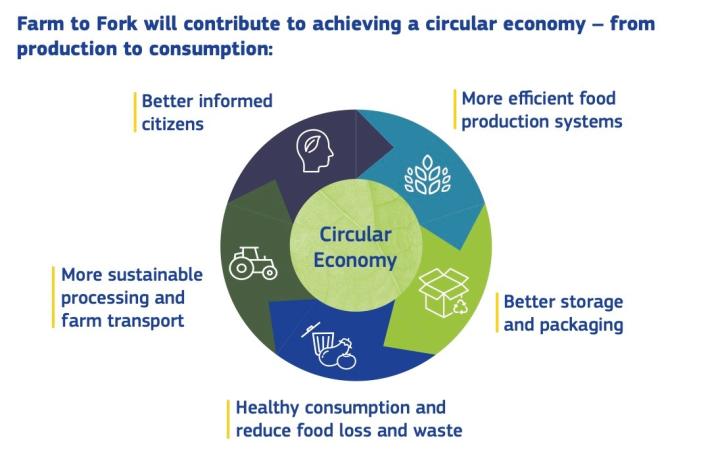
- The Farm to Fork Strategy: This consumer-focused strategy seeks to create a fair, healthy, and environmentally-friendly food system across Europe. It outlines concrete targets, such as a 50% reduction in pesticide use, a 20% decrease in fertilizer use, a 25% increase in organic farming land, and a 50% reduction in antimicrobials used in farm animals.
- The Biodiversity Strategy for 2030: This strategy tackles the root causes of biodiversity loss, including unsustainable land use, resource overexploitation, pollution, and invasive species. It proposes specific actions like bringing back pollinators to agricultural land, encouraging organic farming and other biodiversity-friendly practices, and establishing binding targets for ecosystem restoration.
These complementary strategies play a crucial role in ensuring a more sustainable future for European agriculture and the environment.
Support during times of crisis
In addition to measures designed to stabilise agricultural markets, the European Commission has legal tools that allow for swift responses during times of disruption in the agriculture sector.
From 1 January 2014 to the end of 2023, a total of 63 exceptional measures were adopted by the Commission to support farmers and producers during emergencies such as the Covid-19 pandemic and Russia’s illegal invasion of Ukraine.
These measures channelled more than €2.5 billion of EU funds to agricultural sectors and included a support package of €500 million in March 2022 to support producers most affected by the consequences of the war in Ukraine.
At the same time, a Temporary Crisis Framework to enable Member States use the flexibility of State Aid rules to support their economies was adopted. Now officially called the Temporary Crisis and Transition Framework (TCTF), it was partially extended until at least December 2024 to address persisting market disturbances in agriculture and fisheries sectors.
The Commission also responds to adverse weather events by mobilising additional EU funding for farmers dealing with the consequences of climate change.
In 2023, Irish farmers were allocated €9.5 million of EU funds out of a total of €330 million mobilised for Member States affected by climatic events, high input costs, and diverse market and trade related issues.
A European Food Security Crisis preparedness and response Mechanism (EFSCM), set up in response to the Covid-19 pandemic, maps out risks to the EU food supply chain and coordinates the response to threats such as those caused by Russia’s invasion of Ukraine.
Agricultural Market measures explained
Exceptional agricultural market measures
Irish agriculture: facts and figures
- 99% of Ireland is covered by predominantly rural and intermediate regions, more than double the EU-27 average.
- There are around 135,000 farms in Ireland, with an average farm size of 33.4 hectares.
- Farms in Ireland have become increasingly specialised towards livestock production, particularly beef and dairy.
- Ireland has 127,000 active farmers and the total labour productivity in this sector is high. However, employees in this sector have low income levels compared to other sectors of the economy.
- Under the Irish CAP Strategic Plan, around 300,000 people will benefit from advice, training, knowledge exchange or participation in EIP operational groups, mainly in the field of environmental or climate-related performance.
Latest agriculture news
The European Commission has adopted a Communication clarifying the use of force majeure and exceptional circumstances for the EU agricultural sector in case of unforeseeable and extreme weather events.
Delivering on its commitment to ease administrative burden for EU farmers, the Commission has proposed to review certain provisions of the Common Agricultural Policy (CAP), aiming to deliver simplifications while maintaining a strong, sustainable and competitive policy for EU agriculture and food.
The European Commission has launched an online survey to gather directly the views of EU farmers. The survey is open from 7 March to 8 April 2024.